
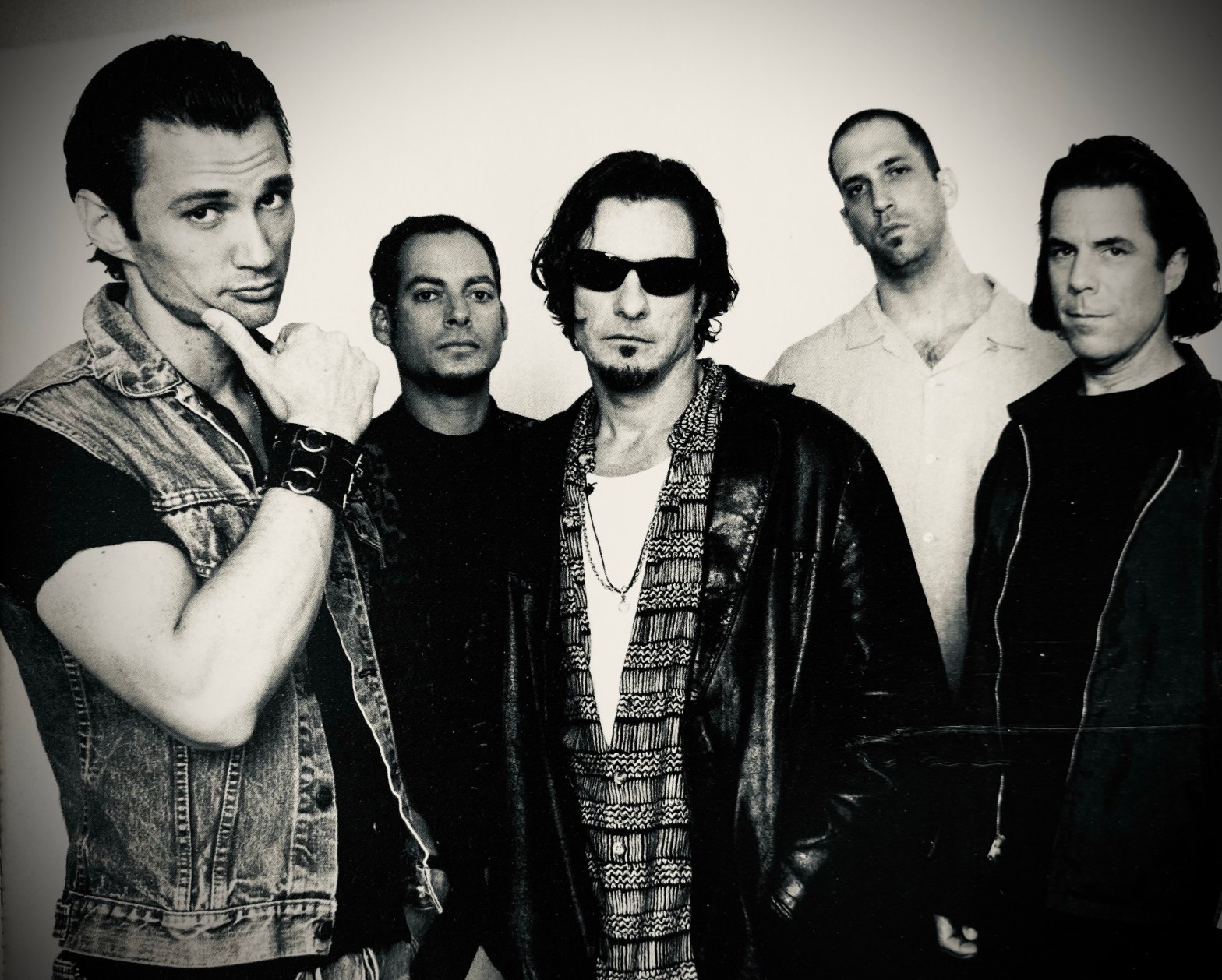
Among the many articles Jasper Heikens compiled for the original Lester Butler Tribute Site are several from Oor music magazine from The Netherlands. That collection includes this intriguing interview with Lester Butler in 1997, published in issue No. 19.
The story is presented here with Jasper’s original English translation updated by NoFightin.com.


Mouthharp-player/singer Lester Butler is the biggest outsider from the current bluesscene. He is responsible for the most exciting, intense hard rocking blues from the ‘90s. First with The Red Devils, later with 13.
“When people ask me why I play the blues, I’ll have to look back far and think hard. It’s so deep in my soul. It’s just like you ask a fish, why do you swim? A fish doesn’t know he swims, he just swims.”
by Herman van der Horst
Music helps me escape my head.
Lester Butler (middle on picture) wears as long as he can remember mouthharp in his pocket. In the beginning it was the only instrument he could afford. As a 6-year-old he knew how to copy the sound of Little Walter and Sonny Boy Williamson. But he didn’t know who they were. “I had a little toy harmonica, and you know how kids are, they’re just sponges.”
Shortly afterward he moved to Los Angeles with his mother, where he, in his teens, was taken in by Hollywood Fats, the legendary guitarist/mentor who performed in groups such as The Blasters and The James Harman Band. The sudden death of Hollywood Fats in 1986 was the reason for Lester to climb on stage himself. He mainly played at school parties, “everything from Little Walter to the Sex Pistols.” Lester describes himself not only as a “child of the blues,” but also as a “punk rocker at heart” (most recently, he played on the latest record of the Berkeley punk group Rancid). Which takes us straight to the heart of the Butler case.
His approach to the blues is different from what is common. He’s based on the typical ensemble like in bands like Howlin’ Wolf and Muddy Waters, where guitar, piano and harmonica all had an equal role. So instead of everybody (like in most bluesrock) playing solos in succession over a 12-bar shuffle, Lester lets his players on the same time playing against each other. And that with a maniac urgency. “My music is dictated by the movement of my body. And I move hard and pursue.”
In the blues scene Lester Butler is therefore viewed with skewed eyes. “I am the rebel. The outlaw. Because I’m convinced that Howlin’ Wolf was the most outrageous punk at the time. You can also consider his music as punk. He was an innovator and such a seditious, savage, and idiotic noisemaker, that he relegated the rest to tame little bunnies. The same was true of Elmore James, who played and sang so loudly that his heart gave out. These people lived and played with an unprecedented intensity. Such uninhibited self-expression and originality seems to have been completely forgotten in today’s blues world.”
On December 19, 1988, a new club opens his doors in Los Angeles. It’s on the location of the corner of 6th Street and La Brea Avenue, in a former Chinese restaurant, called King King. That same night a few musicians perform, which will be the regular houseband.
They are: Lester Butler, brothers Dave Lee and Jonny Ray Bartel, and Bill Bateman. Soon known as The Red Devils. Their reputation is soon spreaded far outside California. Every Monday night, the small King King club is full and celebrities are soon spotted: Bruce Willis, Wynonna Judd, Peter Wolf, Mick Jagger and members of The Black Crowes.
Rick Rubin becomes one of the frequent visitors. Then he decides to record them live for his Def American label. King King was set and is one of the most exciting blues CDs of the ‘90s. Soon Rick Rubin gets Mick Jagger to record with The Red Devils. In the days of the recordings of Jagger’s solo CD, Wandering Spirit, a session was done with the Devils. In one day they record 14 numbers (all Chicago blues covers). The same thing was done with Johnny Cash, but these tapes also end up on the shelf.
In the meantime, fans are anxiously awaiting the second Red Devils album, but insiders have long known that the group is doomed. Jimmy Rip, the guitarist who played with both Jagger and the Devils: “If you’d known those five asshole wise guys, you’d have known for sure that they could never, ever stay together. They were constantly fighting each other.”
According to Lester Butler, rhythm guitarist Dave Lee Bartel was the main culprit. Because Bartel had come up with the name Red Devils, he believed it was his group.
“He turned the other members against me. They wanted to lecture me, of all things, in my own group.” In addition, Butler’s only ally and apple of his eye, young lead guitarist Paul “The Kid” Size, moved back to his Texas town because he couldn’t handle life in L.A. End of Devils.
Butler does not expect this history to repeat itself with this new group, because he himself provided the name for it: 13.
An unlucky number for most people, but not by Butler’s book. He believes that 13 represents the struggle against misfortune and hard times and that that struggle ultimately makes you a stronger and better person. That Butler speaks from experience can be concluded from the song “Plague Or Madness” on 13’s beautiful debut album of the same name. This dangerous-sounding stomper is sung from the perspective of a serial killer (“I’m into homicide!”).
History: From Screamin’ Jay to Icepick James to 13 … the birth of a ‘Plague’
Butler calmly declares it to be autobiographical. “Plague Of Madness was created during a crazy hot flash in the studio, which coincidentally included the band. It is based on my countless experiences of being hunted, threatened, and attacked in the bad neighborhood I lived in (downtown L.A.). I was also furious with a guy who took my girlfriend. It wasn’t until I heard the song back that I realized how stupid that attitude is. Even the music is comically insane.”
Then the dark monkey comes out of the sleeve at the last minute. Lester Butler appears to have lived the same dangerous and destructive lifestyle as his hero Little Walter all his life. “I use alcohol and drugs to push the boundaries,” he confesses. “Sometimes I wish it were different, because life is hard. But I was just born that way. I hope that my drug use also produces something positive, because it has already caused me so much negative.”
Butler explains that the escaping high he gets from drinking and drugs is similar to the high from music. He needs both highs. “I don’t want to think of myself as crazy. But there is an unbearable pressure in my head. Music helps me escape my head. It heals me. Music gives me — to quote Howlin’ Wolf — something Kings and Queens can never get.”
 No Fightin'